Drop Caps
Type the paragraph right on the block and its first letter drops across two lines, or three, or eight. Bold, italic and links work inside it.
The last orchard on Route 9W
Walt Hartwell keeps the 1871 deed in a coffee can above the cider press. His great-great-grandfather paid $310 for forty acres of rocky slope above Milton, and the family has picked apples there every fall since. This year, for the first time, nobody is lined up to take over.


Contents
Six stories, four of them about people who work with their hands, one about a road at night, and one about a man and his tractor. Everything starts on the page number on the right.
Sixty-seven issues, and the letters still come by hand
Eleven kinds of apple and one stubborn tractor
The bakery that closes at nine
Forty mugs a week in High Falls
Two days, one paper map
The Hollow Road, After Dark
Sixty-seven issues, and the letters still come by hand.
Every issue starts on the long table in our office on Wall Street, with the letters you send. Some are corrections (we did get the date of the Hurley Corn Festival wrong, twice). Some are tips. One, from a reader in Saugerties, was a single line: go and see the man with the orchard on 9W before it’s gone. So we did. Celia spent eleven Saturdays there, and the story she brought back is the longest we have ever printed.

Eleven kinds of apple and one stubborn tractor
The tractor is a 1964 Farmall, red where it isn’t rust, and it starts on the third try every morning at 6:40. Walt says it has never once started on the first try, and that if it ever does he will sell the place that afternoon. He says this the way other people talk about the weather. His hands are on the wheel, the radio is on WAMC, and a crate of Macouns is sliding around the trailer behind us.
Saturday is the busy day. By nine the field by the barn is full of cars, half of them with Connecticut plates, and the line at the donut window reaches the scale. Walt sits on an upturned crate by the gate and takes the $24 for a half-bushel bag in cash, mostly. He knows the regulars by their cars.

Ten minutes with the man on 9W
What happens to the orchard next year? I don’t know yet, and I’ve stopped pretending I do. Ellen comes down on Sundays and we talk about it over lunch, and then we talk about something else. If somebody young wants to learn it, properly, I’ll teach them for nothing. They can keep the tractor. Your favorite apple? A Northern Spy off the top row, after the first frost, eaten standing up. Anything else is a compromise. And the Honeycrisp? It pays for the Northern Spies. Don’t print that.
Night Pages
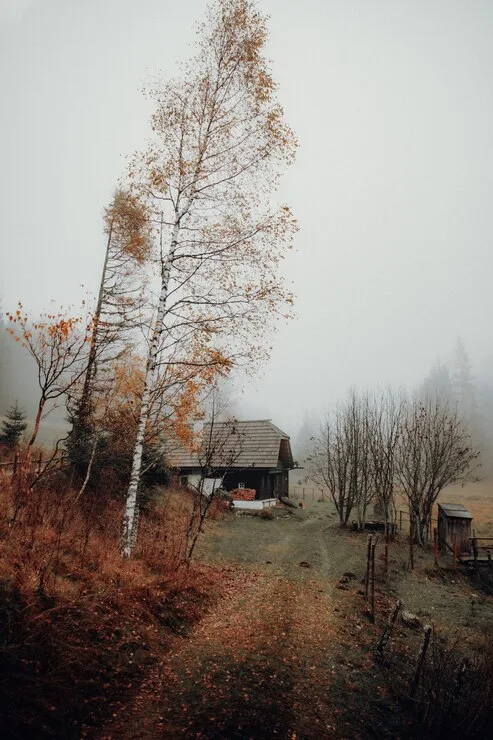
The Hollow Road, After Dark
Mother never let us drive the Hollow Road after dark, and she never once said why. So of course we did, my brother and I, the October I turned sixteen and he was eighteen and leaving for the Navy in a week. We took the Ford with one headlight and a thermos of cocoa that was mostly sugar. The road went up past the Vandermark place, where the barn had already started to lean, and then it went into the trees, and the trees closed over us like a lid. Neither of us said anything for a mile. Then Tom laughed, the way he did when he was frightened, and turned the radio up. There was nothing on it but a man reading the farm prices from Albany, eggs and feed corn and hogs, very slowly, as if he had all night. We listened to every word.
The Almanac

October 18 and 19, the Hurley Corn Festival is back on the town green (yes, the third weekend, we checked), with a pie table run by the fire auxiliary that is worth the trip alone. October 25, Kingston’s Stockade District hosts its first lantern walk, leaving from the corner of Wall and North Front at 6 pm; bring a flashlight anyway. October 26 is the last day of picking at Hartwell Orchards in Milton, and the donut window stays open until the cider runs out. November 1, the Rosendale Theatre shows the 1958 print of Vertigo, $9 at the door, with a talk by a retired projectionist who has threaded it four hundred times. November 8, potters from eleven studios open their doors along Route 213 between High Falls and Stone Ridge; maps are at the High Falls Post Office from 9 am. November 15, the Saugerties Lighthouse lets the public climb to the lamp room for the last time this year, tickets $12, children under ten free. November 22, the Kingston Farmers Market moves indoors to the Old Dutch Church hall and keeps its hours, 9 to 2. And on November 29, the Phoenicia Bread Co. sells its once-a-year cranberry walnut loaf. Get there before seven. We mean it.
Bread, clay and twenty-six miles on foot.

The bakery that closes at nine
Phoenicia Bread Co. bakes 220 loaves a night in a former gas station on Route 28. Mira Haddad opens the door at six and is usually sold out before the school bus goes by. The rye is $9 and worth the drive from Kingston.

Forty mugs a week in High Falls
Jun Takeda throws on a wheel he bought from a retiring art teacher in 2011. His glaze is the color of the creek behind the studio.

Two days, one paper map
Owen Marsh walked twenty-six miles of old carriage roads with a paper map and a bag of Macouns. He got lost once and recommends it.
You wrote back.
Your summer piece on the Wallkill rail trail sent my husband and me out on our bikes for the first time in eleven years. We made it to Gardiner and took a taxi home. Next year, the whole way.
A correction, with love: the diner in the spring issue opened in 1951, not 1953. I know because my father poured the first cup. He would want you to know the pie was better then, too.
I have kept every issue since number 9. My wife says the stack by the stairs is now a fire hazard. Would you consider printing a smaller magazine, or selling me a bookcase?

I moved here from Houston in March and knew nobody. I went to three things from your Almanac in one weekend and now I am on the library board. Thank you, I think.
Please stop telling people about the swimming hole on the Esopus. We had it to ourselves for thirty years.
Four issues a year, in your mailbox.
Dear reader, a subscription is the only reason we can send a writer to an orchard for eleven Saturdays. We take no money from developers, the county or anybody selling a timeshare. The ads are from businesses we would recommend anyway, and there are never more than twelve of them in an issue.

Kingston, NY 12401
(555) 018-4420
Mon to Thu, 9 am to 4 pm
$0.60 a word, we answer in three weeks
Twelve ads an issue, no more